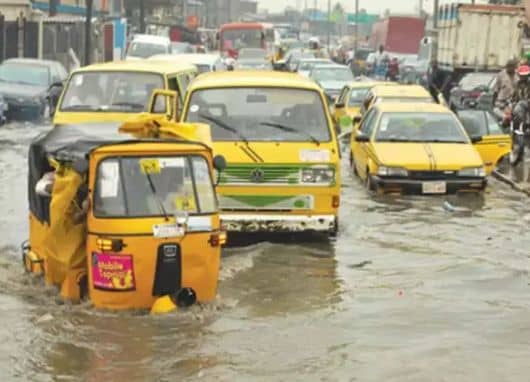
The Lagos State Government has acknowledged that flash flooding will persist in the state due to climate change and environmental factors. However, it reaffirmed its commitment to enhancing infrastructure to provide long-term solutions.
Environment and Water Resources Commissioner, Tokunbo Wahab, made this disclosure during a television interview, highlighting the ministry’s efforts over the past two years. According to Wahab, the ministry has cleaned over 50 kilometers of secondary collectors and maintained or dredged approximately 38 primary channels across Lagos.
Wahab cited the recent 14-hour torrential rainfall in Ikorodu, noting that immediate remedial measures were taken. He explained that a contractor had been instructed to free the dammed downstream area to allow stormwater to recede.
The commissioner recalled that the Nigerian Meteorological Agency (NIMET) had issued an early forecast in March, prompting the ministry to launch massive advocacy efforts in April. Residents were repeatedly briefed about the expected high rainfall levels, and those in low-lying areas were advised to temporarily relocate to upland areas.
Wahab also revealed that the Emergency Flood Abatement Gang (EFAG) had cleaned around 666,000 meters of drainage systems and manholes across all LGAs and LCDAs. He emphasized that climate change is a global reality, citing examples of countries experiencing unprecedented flooding.
Regarding drainage infrastructure, Wahab explained that contracts awarded in 2024 have an 18- to 24-month lifespan, and the government prioritizes quality over speed. Temporary measures, including pumping stations on Lagos Island, will continue to mitigate flooding until permanent solutions are completed.
Ongoing projects include System 44 in Lekki, System 44A, and the three-phase System 1 (Odo–Iyalaro) project, which channels stormwater from Ikeja, Opebi, and Sheraton areas into the lagoon.
“We expected the rains and had resilient measures in place,” Wahab said. “We have been doing massive advocacy and ramping up drainage infrastructure statewide. We won’t lie to residents – flash flooding will occur, but we are working to contain it.”