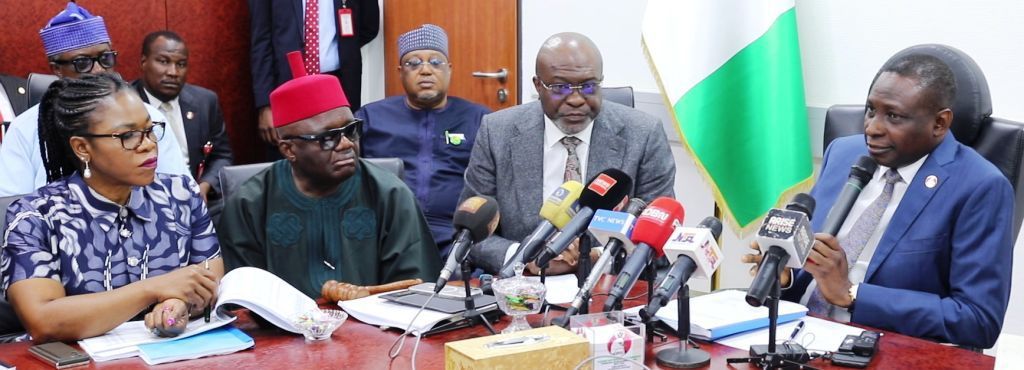
The Executive Chairman of the Economic and Financial Crimes Commission (EFCC), Mr Ola Olukoyede, has emphasised the critical importance of asset recovery in the battle against economic and financial crimes, describing it as a major deterrent against corrupt practices. He made this statement on Tuesday, 12 November 2024, while addressing members of the House of Representatives Committee on Financial Crimes during their oversight visit to the EFCC’s corporate headquarters in Abuja.
Mr Olukoyede stressed that the process of recovering assets linked to financial crimes is a significant challenge, describing the retrieval of even one billion naira as a “war.” He said, “If you understand the intricacies involved in financial crimes investigation and prosecution, you will discover that to recover one billion naira is war. So I told my people that the moment we start investigation, we must also start asset tracing because asset recovery is pivotal in the anti-corruption fight.”
He further explained that depriving suspects of access to proceeds from their alleged crimes is a crucial tactic. “If you allow the corrupt or those that you are investigating to have access to the proceeds of their crime, they will fight you with it. So one of the ways to weaken them is to deprive them of the proceeds of their crime,” he said. According to Olukoyede, the EFCC has modified its operational strategies to focus on asset tracing at the start of every investigation, which has bolstered their recovery efforts.
Olukoyede highlighted that no anti-corruption fight could be deemed successful if it did not contribute positively to Nigeria’s economic progress. He reminded the Committee of his three policy objectives, which he had outlined during his Senate confirmation last year. Since October 2023, under his leadership, the EFCC has recovered around ₦250 billion in cash, along with tens of millions of dollars, pounds sterling, and other currencies.
In addition to asset recovery, Olukoyede reported that the EFCC had made significant strides in securing convictions, achieving approximately 3,500 successful prosecutions between 18 October 2023 and 18 October 2024. He cautioned against underestimating crimes like cyber fraud, often dismissed as “yahoo yahoo,” noting that such offences cost the nation over $500,000 in a single year. “This issue of yahoo yahoo thing that some people are treating with kid gloves is a crime that cost the nation over $500,000 (Five Hundred Thousand United States Dollars) in one year and that is what some people are joking about,” he said. He acknowledged the challenges of anti-corruption work but affirmed the EFCC’s resolve to continue its efforts, despite criticisms and resource constraints.
On corruption prevention, Olukoyede highlighted the Commission’s increased focus over the past year, with a shift towards a proactive stance. A new Directorate, the Fraud Risk Assessment and Control (FRAC), has been established to collaborate with the Office of the Accountant General. This Directorate is tasked with scrutinising financial disbursements and monitoring the implementation of projects within Ministries, Departments, and Agencies (MDAs).
The EFCC Chief noted that less than 20 per cent of capital projects had been executed over the past two decades, a situation he aims to improve. The goal for the current year is to reach a 50 per cent execution rate of capital projects in collaboration with the new Directorate and the National Assembly. “If we do 50 per cent, we will be fine as a nation,” he concluded.
The EFCC’s focus on asset recovery, conviction rates, and fraud prevention underscores its commitment to eradicating corruption and advancing Nigeria’s development, despite the persistent challenges associated with economic and financial crime.