“Ajo,” is a traditional rotating savings scheme has become a lifeline for many market women who describe it as more reliable and accessible than commercial banks.
Ajo operates on the principle of collective contribution: members contribute a fixed amount regularly, and one participant receives the pooled sum on each scheduled turn. The cycle continues until every member has been paid.
What may appear simple on the surface serves as a critical source of support for women navigating economic pressure and financial exclusion.
A system that saves lives
For 53-year-old tomato seller Alhaja Kabirat, Ajo has been the backbone of her survival. A widow with four children, she recalls how the system supported her during her toughest seasons.
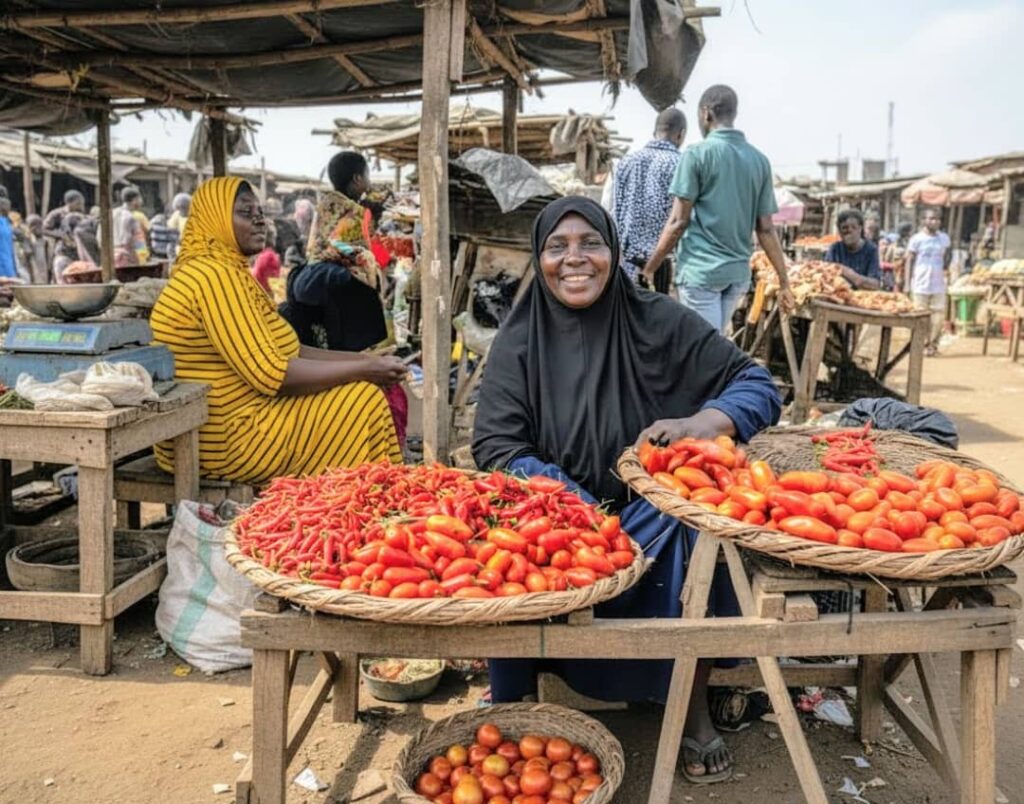
“The banks couldn’t help me when I needed help the most. I didn’t have anything to use as collateral, so banks refused to give me loan,” she said with a sad smile. “I got introduced to Ajo by my neighbour, I registered and bought my card. My Ajo people became a quick answer to my money problems.”
During the recent naira scarcity, when Nigerians struggled to access cash and businesses shut down, her tomato business was also on the brink of collapse. But on the day she received her ₦15,000 payout, she moved quickly.
“I didn’t even wait to count the money,” she added. “That Ajo turn was like a renewed hope for me. Life is hard already for me but Ajo is one of the few things that still works well for me.”
When Ajo turns struggle into opportunity
For Rita Chinoso, 37, Ajo became her anchor after her husband lost his job during the pandemic. She remembers the evening he returned home devastated.
“He came home one evening with a letter and tears in his eyes saying I am finished, my job is gone and I have nothing. No savings. I was afraid.”
Rita earned only when her school was in session, and without savings, she desperately sought a loan.
“I went from bank to bank , trying to get a loan to enable me start a sideline business and also combine with the teaching job so as to get more more but alas I couldn’t secure the loan.”
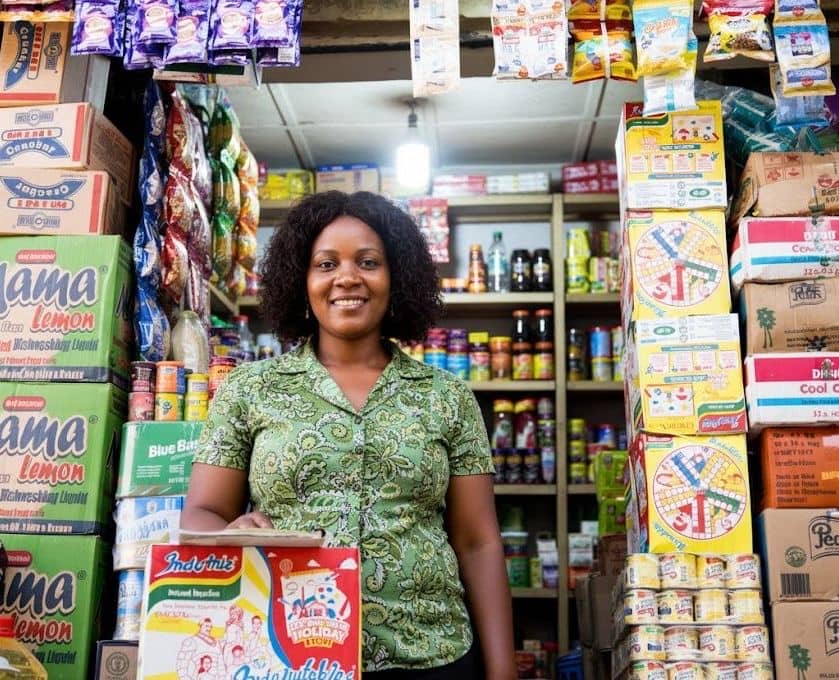
A church member introduced her to an Ajo group. She borrowed ₦5,000 to register.
“The first cycle gave me ₦40,000, which I used in buying my first batch of goods. From there, my business grew, I now have a provision shop.”
Her shop now thrives, but she remains committed to her group.
“Now, I sell every day and I make good profit but I didn’t stop the Ajo. We all gathered little money, but that little money became my turning point. That’s what Ajo does, it gives you something to hold onto, and I’m proud to be a member of an Ajo group.”
A younger generation finds its footing
Among younger traders, Ajo is gaining renewed relevance with digital adaptations. Abigail Kolawole, who sells phone chargers and accessories, joined a WhatsApp-based group of vendors.
“I used to think Ajo was for old women,” she laughed.
Her perception changed when she observed her friend’s experience.
“But one day my friend got ₦50,000 from her turn, and she paid her shop rent just like that while I was still struggling to gather my own rent. I joined immediately.”

She contributes ₦1,000 daily and credits the system for helping her stay financially disciplined.
“If I try to save by myself, I’ll spend it,” she admitted. “But when I know it’s for my group, I don’t touch it. And when it’s my turn, I feel rich.”
Trust can be broken
But trust the backbone of Ajo is not always enough to prevent loss. Mama T, a popular spice seller in Ogijo market, recounted her experience with a dishonest Ajo collector.
“I contributed my hard earned money daily to this woman, without knowing she had an interior motive, when it was time to collect the money from her, she ran away with my money. I was broken, and I felt so bad. I had plans of using the money for something else but she gave me the shock of my life.”
The incident shattered her confidence.
“Now, I don’t trust Ajo groups and I don’t think I will ever entrust my money to a total stranger again.”
She says she would rather use a bank, despite the limitations.
“I rather take my money to the bank where it will be safe. But if I must join one again after that horrible experience, then it has to be a strict one where only members who’ve built trust are allowed to collect the money. I can’t be cheated twice in the name of Ajo.”
A tradition that refuses to fade
Despite occasional risks, many women in Ogijo say they have limited alternatives. They rely on Ajo cycles not only to save but to survive. For them, the immediate access to cash outweighs fears of loss, and the support from one another remains invaluable.
In Ogijo’s busy markets, Ajo is more than just a financial tool , it is a community, a support system, and an anchor in difficult times.
As one woman summed it up:
“To many of us, Ajo is more than saving, it’s survival and sisterhood. It is financial inclusion at its rawest. While fintech apps offer convenience, and banks offer services, Ajo offers humanity.”