The Vice Chancellor of Lagos State University of Science and Technology (LASUSTECH), Prof. Olumuyiwa Odusanya, the Senator representing Lagos East, Senator Tokunbo Abiru, and the President of the Manufacturing Association of Nigeria (MAN), Otunba Francis Meshioye, have unanimously declared that robust university-led research is critical to preventing human extinction and rebuilding Nigeria.
They issued a stark critique of Nigeria’s university system, declaring that the nation is losing both prestige and economic value because academic research is disconnected from industry and real-world problem-solving.
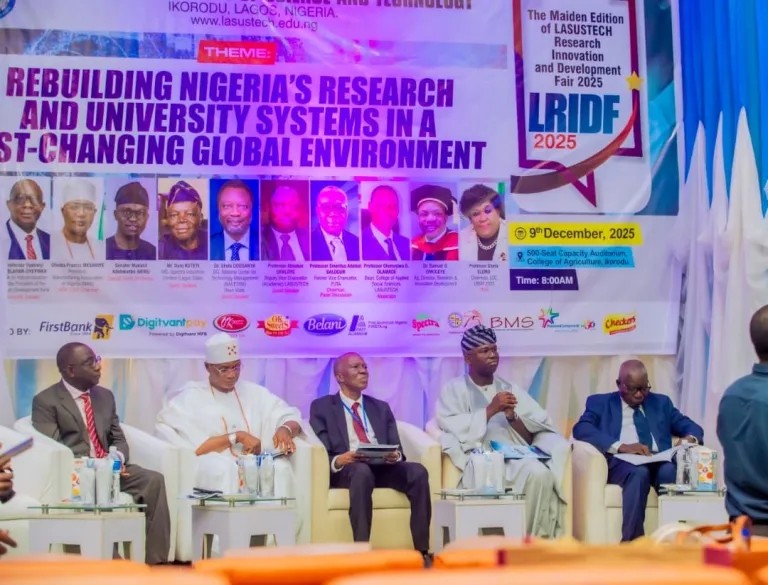
They made the declaration at the inauguration of tbe maiden edition of LASUSTECH Research Innovation and Development Fair 2025 on Tuesday, December 9, 2025 on Ikorodu campus.
In his opening remark, the VC, Prof. Odusanya stated that for a nation to be great, it must build great universities, which serve as engines of development through both visible economic activity and the “invisible” work of research.
He defined research as the fundamental interrogation of problems to proffer solutions, calling it an urgent necessity for national progress.
The Vice Chancellor, who revealed that he led the clinical trials for the conjugate pneumococcal vaccine now used in Nigeria’s national immunization programme, cited it as a prime example of how university professors must solve national problems.
He urged a shift from basic to translational research, pointing to global advances in genetic engineering, quantum computing, and telecommunications as benchmarks.
Odusanya emphasised that research cannot be done in isolation, highlighting the need for strong teams, industry collaboration, and grant-winning skills.
The ongoing fair, he noted, is designed to foster these partnerships, allow peer review, and showcase prototypes ready for commercialization.
He announced that the LASUSTECH administration has actively supported staff through grants from TETFund and conferences, pledging continued commitment.
A direct appeal was made to industry leaders to partner with the university, ensuring research translates into tangible societal benefits.
Also speaking, Senator Abiru said Nigeria must invest in research or fall behind in tech race. He warned that the country risks being left behind in the fast-paced global economy if it fails to urgently reinvest in its university research and innovation systems.
He emphasised that nations failing to invest in research and human capital development “risk falling irreversibly behind, and Nigeria must not be left behind.”
The Senator praised the university for initiating the fair, stating that such efforts are critical to “reimagine, re-engineer and reinvigorate” the country’s research enterprise.
Highlighting the gap between potential and support, Abiru noted: “Our universities are filled with brilliant minds however, what they require are adequate funding, functional laboratories, [and] strategic industry partnerships.”
He argued for transforming universities into economic hubs, stating, “It is about transforming our universities into hubs where knowledge translates into economic value and job creation.”
On government efforts, Abiru highlighted the President’s digital infrastructure plans, including a 90,000-kilometer fibre optic project, as a positive step.
He told the students in attendance, “The future of growth, the future of wealth, is in technology.”
In his legislative role, Abiru pledged commitment to “promoting policies that will strengthen our national research ecosystem,” including facilitating funding for startups and supporting university research capabilities.
On his part, the President of the Manufacturing Association of Nigeria (MAN), Otunba Francis Meshioye, pointed to the 2025 Times Higher Education World University Rankings, dominated by institutions like Oxford, MIT, and Cambridge, as the global standard.
He noted: “University are increasingly judged not merely by enrollment capacity but by the quality, feasibility and impact of their research at a global level. These top-ranked institutions, he explained, excel due to “strong research ecosystems, high citation impact, significant international collaboration, and the integration of industry.”
The MAN president identified a confluence of systemic failures causing this lag.
Chief among them is chronic underfunding, with Nigeria investing less than 0.3% of its GDP in research and development which lower than the global average of 1.95%
“This underinvestment has a direct economic cost, as a nation that under funds research will overpay for imports. Further crippling factors include research that fails to reach top international journals, reducing its global visibility and impact, and a weak connection between research and industry.”
Meshioye lamented that many innovations remain confined to thesis and academic archives, rather than being translated to products, patents or industrial solutions.
This disconnect is exacerbated by a persistent brain drain, which he cited as seeing “239 professors lecturers disengage their services” between 2015 and 2023 due to poor remuneration.
“Research is not for decoration. It is for development,” he asserted forcefully, adding: “When Nigerian universities produce knowledge that does not reach industries, we lose price. We lose the money we spent on research and the money we eventually pay to import the same solutions.”
To reverse this decline, he proposed a concise five-point plan focused on actionable collaboration.
Key recommendations include universities and industries co-creating research focused on national problems like power and food security; promoting lecturers based on patents and partnerships, not just publications; and making industry internships mandatory.
He directly appealed to government to meet up with the UNESCO minimum benchmark of allocating 15% of its total budget to education and to give tax breaks to industry that fund universities research.
Meshioye concluded by calling for a fundamental mindset shift, saying: “University must see themselves as problem solvers, not just certificate givers. Industry must see University as partners, not just suppliers of labor. And government must really see funding as an investment, not as an expense.”
He expressed MAN’s readiness to partner with the university, framing the needed change as a “new covenant between town and gown” essential for translating Nigeria’s abundant talent and knowledge into tangible national prosperity.